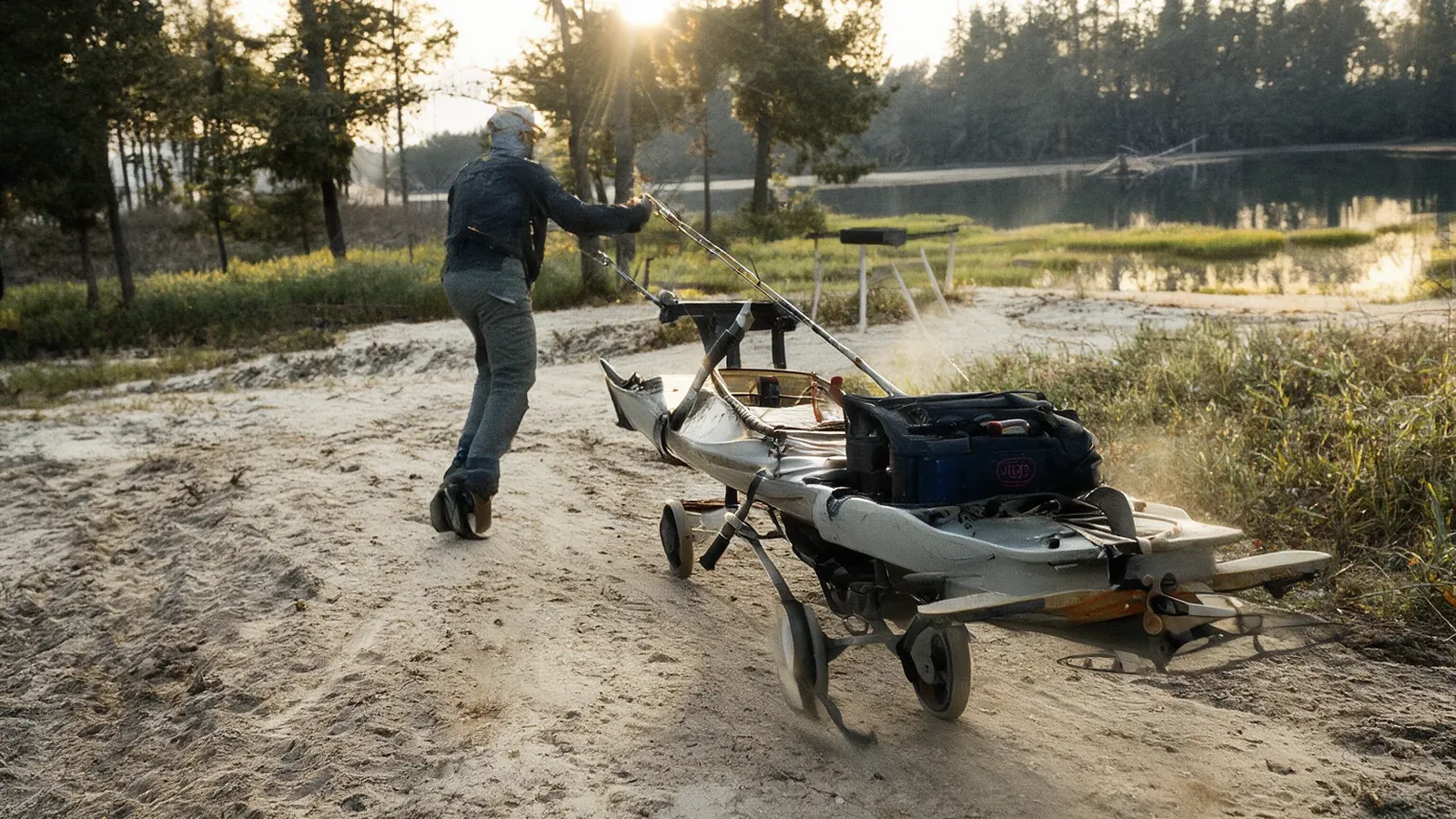
A cart is what gets a loaded fishing kayak from the car to the water without wrecking your back. Pick the style for your hull and launch: strap-on bunk carts fit any kayak, scupper carts slide into the scupper holes with no straps, and balloon sand tires float over beaches. Match the capacity to your fully rigged weight. Picks sorted by price.
At a glance
The picks
1. Bonnlo Universal Kayak Cart
A budget aluminum-frame cart with no-flat solid tires and a spring-loaded kickstand. A 165 lb capacity, tool-free assembly and a folding design cover lighter kayaks and general hauling for the least money.
Posts slide into the scupper holes, so there are no straps to tie. The frame adjusts for hole spacing from 3.25 to 16 inches, and the 10-inch airless tires cannot go flat. Rated for 150 lb, it suits lighter sit-on-top kayaks.
The cart that breaks down to fit inside your kayak. Tool-free assembly, a 265 lb capacity and non-corroding polymer with stainless axles — ideal when trunk or hatch space is tight.
A reliable, premium cart with puncture-proof airless wheels and a 150 lb capacity that folds flat for storage. The trusted choice for hauling a loaded kayak to the launch without a flat ruining the day.
A step up in capacity: the bunk-style frame is rated for 250 lb, enough for a loaded fishing kayak. It weighs 11.25 lb, has airless no-flat tires and an integrated cam strap, and Malone backs the frame with a lifetime limited warranty.
Air-filled 14-inch balloon tires run at about 3 psi for sand and mud. The bunk cart holds 242 lb, weighs 11 lb 1 oz and breaks down without tools into five parts that fit most hatches. Sand tires carry a 6-month warranty.
What to look for
Bunk carts strap on under any hull. Scupper carts drop posts through the scupper holes — quick and strap-free, but only for sit-on-tops with suitable hole spacing. Wide balloon tires are the answer for soft sand.
Add hull, gear, battery and crate — then pick a cart rated above that. Loaded fishing kayaks routinely hit 120–150 lb.
Pneumatic tires roll softest but go flat; airless/solid tires never puncture — the safer bet for a cart that lives in a hot garage or truck bed.
Some carts (like the C-Tug) knock down to fit inside your hatch so you can bring them along; others fold flat for the car but ride on shore.
Frequently asked questions
Only if your kayak is a sit-on-top with scupper holes in the right place and the hull can take the load there. Check the spacing range on the cart (the Malone XpressTRX adjusts from 3.25 to 16 inches) against your scuppers, and use a strap-on bunk cart for sit-ins, inflatables and pedal hulls with drive wells in the way.
If you fish alone or launch any distance from parking, almost certainly. A loaded fishing kayak can weigh 100–150 lb, and dragging it wrecks the hull and your back. A cart turns a two-person struggle into a one-person stroll.
Add up your hull weight plus gear, battery and crate, then choose a cart rated comfortably above it. Many rigged fishing kayaks hit 120–150 lb, so a 150–265 lb capacity cart gives useful headroom.
For most people, yes. Airless or solid tires never go flat — no small comfort when your cart lives in a hot garage or truck bed between trips. Pneumatic tires roll a little softer over rough ground but need air and can puncture.
How we chose
Every spec here is pulled from the manufacturer or an authorized retailer and standardized. We rank transparently and never for commission. Full methodology →